

CG Policy · 2025
In this section7 topics
Corporate Governance Policy
Introduction
The Company is aware of the importance of compliance with the principles of good corporate governance and is confident that the process of good corporate governance is a key factor to help increase the efficiency and effectiveness of the Company’s operations to achieve objectives and missions, in addition to serving as the basis of sustainable growth under related laws, ethics, care for the environment and society, as well as building credibility and trust among all groups of stakeholders.
The Company has established a written Corporate Governance Policy, duly approved by the Board of Directors. This includes the Good Corporate Governance Policy and the Code of Conduct, both of which undergo a mandatory annual review to ensure they remain current and effective. It is the mission of every director, executive, and employee to acknowledge and strictly adhere to these guidelines. The Corporate Governance Policy is disclosed in the 2025 Annual Registration Statement (Form 56-1 One Report) and is accessible to all stakeholders on the Company’s website at: https://www.tollway.co.th/storage/document/cg/dmt-corporate-governance-policy-th.pdf. Additionally, the policy is disseminated via the Company’s Internal Intranet system to ensure comprehensive awareness throughout the organization.
Has a Corporate Governance Policy
Yes
Policy Description
The Board of Directors has assigned the Audit Committee to supervise and screen matters related to corporate governance, including monitoring, reviewing, and updating the policy to be relevant as well as in compliance with good corporate governance principles by implementing the Corporate Governance Code (CG Code) into the Company’s corporate governance.
In this regard, the Board of Directors and the management emphasize and realize the importance of good corporate governance, which consists of roles and responsibilities of the Board of Directors as leaders, good risk management and internal control, a balanced mechanism of power that leads to transparency, respect in rights and equality of all stakeholders, and a credible finance and information disclosure to increase value and promote sustainable growth of the Company based on good corporate governance.
Policy Document Link
https://www.tollway.co.th/storage/document/cg/dmt-corporate-governance-policy-en.pdf
Policy & Practices — Board of Directors
Has Policy & Guidelines for the Board
Yes
Board Guidelines
| Guideline | Detail |
|---|---|
| Nomination of Directors | Guidelines The Nomination and Remuneration Committee shall consider nominating persons to be appointed as directors, replacing directors who resigned and retired by rotation, with the following criteria: 1. Having qualifications in compliance with the Public Limited Companies Act, the Company’s Articles of Associations, and related laws. 2. Having knowledge, capabilities, and experiences that will be useful to business management and add more value to the Company. 3. The Nomination and Remuneration Committee considers nominating a qualified person for directorship and propose the nominated person to the Board of Directors for submission to the shareholders’ meeting or to the Board of Directors for consideration and appointment. Nominating process The Board of Directors has established process for nominating directors for the Nomination and Remuneration Committee to implement as follows: 1. To nominate a qualified person for directorship to fill a vacant position. In 2025, the Company has given shareholders the right to nominate qualified individuals who is deemed suitable to be elected as the Company’s director by announcing on the Stock Exchange of Thailand and the Company’s websites. However, no shareholders nominated any names to be elected as the Company’s director. 2. To propose a nominated person to the Board of Directors for consideration and appointment (in case of an interim vacancy). 3. To consider proposing a nominated person to the Board of Directors for approval and submission to the Annual General Meeting of Shareholders for appointment (in case of retirement by rotation). The Company’s Articles of Association specifies that in every Annual General Meeting of Shareholders, one third of the directors shall retire. If the number of directors is not a multiple of three, the number of directors closest to one third shall retire. Therefore, an office term of a director shall be three years. The retiring director may be re-elected, as the Company does not specify the number of office terms of a director in the Company’s Articles of Association. Nomination of Independent Directors The Nomination and Remuneration Committee shall nominate and select independent directors according to the Company’s circumstances and needs, in compliance with the laws, Articles of Association, rules, regulations, and relevant regulations of the Stock Exchange of Thailand. The nominees are presented to the Board of Directors for consideration, and must have qualifications as defined by the Company, as well as complying with the requirements regarding qualifications of independent directors according to the Notification of Thai Capital Market Supervisory Board No. Tor.Jor. 39/2016 Re: Requesting and Granting Permission to Offer for Sale of Newly Issued Shares (including the revised version). |
| Determination of Director Remuneration | The Company has a Nomination and Remuneration Committee to evaluate remuneration of directors and executives by considering suitability with duties and responsibilities of the directors, the Company’s financial status and performance, and remuneration of companies in similar size businesses or in the same industry. Directors’ remuneration Remuneration of directors, the Audit Committee, and various sub-committees (excluding the Managing Director) consists of annual remuneration and meeting allowance. In 2025, the Annual General Meeting of Shareholders 2025 on 25 April 2025 resolved to approve a total remuneration of Baht 14 million for the directors, the Audit Committee, and various sub-committees (excluding the Managing Director), and directors’ bonuses of not exceeding Baht 8.00 million. The Board and various sub-committees will receive remuneration according to the following criteria: 1. Remuneration of the Board of Directors, the Audit Committee, and various Sub-committees who are the Company’s Directors (excluding the Managing Director) shall be as follows: 1.1 Monthly remuneration to reflect the duties and responsibilities of the Directors, Audit Committee and various sub-committees. 1.2 Meeting allowance for attendees. 1.3 Bonus to reflect the Company’s annual performance. 1.4 Other benefits and remuneration such as toll coupon, return on securities in the form of warrants or any other securities and return in monetary form other than those specified in (1) to (3) above. 2. Remuneration of various Sub-committees who are not the Company’s Directors and are outsiders is meeting allowances which will be paid under employment contract for each meeting attendee. The sub-committee members who are not directors and are outsiders will not receive monthly remuneration and other forms of remuneration such as success fee, etc. 3. Remuneration of various sub-committee members who are executives or employees receiving regular salary and consultants under employment contract (third party consultants and not the Company’s directors) who receive regular remuneration will not receive meeting allowances and other forms of remuneration other than regular remuneration received. |
| Independence of the Board of Directors from the Management | The Chief Executive Officer and Managing Director positions are nominated by the Nomination and Compensation Committee based on suitable qualifications, that is, individuals with knowledge, competency, and experience that are beneficial to the management to achieve the objectives, strategies, or goals set by the Company’s Board of Directors, as well as having a good understanding of the Company’s business. The Nomination and Remuneration Committee recommends the Board of Director to elect in accordance with the Company’s Articles of Association. |
| Director Development | The company promotes and supports the Board of Directors and the management team in attending training courses, seminars, and activities organized by the Thai Institute of Directors (IOD). All directors have successfully completed the Director Certification Program (DCP) / Director Accreditation Program (DAP) designed for directors. Additionally, the company collaborates with the Stock Exchange of Thailand and the Securities and Exchange Commission to enhance knowledge development and facilitate the continuous exchange of experiences related to the roles and responsibilities of the Board of Directors and various subcommittees. |
| Board Performance Evaluation | The Board of Directors conducts an annual performance evaluation of the Board, with the Nomination and Remuneration Committee responsible for determining the guidelines, criteria, methods, and evaluation process in accordance with its chartered roles and responsibilities. The Board places great importance on ensuring that the evaluation reflects the effectiveness of its operations in alignment with good corporate governance principles. Additionally, the evaluation process allows the Board to collectively assess performance and identify issues for further improvement. The evaluation is based on the following principles: 1. The Board of Directors and sub-committees self-evaluate their performances at least once a year for the Board to consider the results and issues that may be improved to increase the effectiveness of the Board and various sub-committees. 2. Performance appraisal of the Board and sub-committees is assessed as an entity and individually, including the Chairman of the Board. The criteria, procedures, and overall assessment results are disclosed in the annual report. 3. The Company provides external consultants to assist in formulating guidelines and suggesting assessment questions, which provide straightforward and unbiased results. The results are compared against standards to initiate real development. Assessments by external consultants are conducted every 3 years, in which the operations and development plans are presented in the annual report. |
| Corporate Governance of Subsidiaries and Associated Companies | The Board of Directors has established a policy to oversee the operations of the businesses in which the Company invests in order to comply with the criteria regarding supervision of the operations of subsidiaries, including the guidelines for good corporate governance of the Stock Exchange of Thailand that is set as a practice guideline. This policy is an important mechanism that leads to a good, transparent, and auditable management system, as well as the ability to set directions for effectively managing companies that the Company invests or will invest in the future. Moreover, the Company is able to monitor management and operations of the business it invests in order to maintain the investment benefits of the Company. The Company has a policy to control and supervise management and is responsible for the operations of the subsidiary company, including measures to follow up on the management of subsidiaries to maintain the interests of the Company’s investments as follows: 1) Board of Directors shall appoint representatives to serve as directors and executives in its subsidiaries, taking into account the Company’s shareholding proportion. The Board shall review and determine the board and management structures of these subsidiaries by ensuring that personnel from the Company are appropriately positioned as directors and executives to oversee their operations. 2) In the case of appointing a representative to serve as a director and/or executive in a subsidiary company less than the shareholding percentage, an approval must be acquired from the Board of Directors. 3) In cases 1 and 2, representatives who hold positions as directors and/or executives in a subsidiary company will manage and be responsible for operations of the subsidiary company. There will be measures to follow up on the management of the subsidiary in order to protect the Company’s investments without affecting the authority of the Company. There will also be a policy to take action on matters that have significance or impact on the financial position and operating results of the subsidiary, or an appropriate balance of power in such subsidiaries to supervise and control business operations. 4) The Company’s representatives must act as a director and/or executive of the subsidiary with responsibility to supervise and monitor that operations of the subsidiary are in compliance with relevant laws and regulations, including Corporate Governance Policy and Code of Conduct, Anti-corruption, and other Company’s policies. 5) The Company’s management team will supervise subsidiary company to act in accordance with approved authority and operations, including any action complying with the rules of Securities and Exchange Commission and the regulations, announcements, orders or requirements of the Stock Exchange of Thailand. This includes compliance with regulations regarding disclosure of information regarding related transactions and/or the acquisition or disposal of assets. 6) The subsidiary company is responsible for reporting the operating results and management of the subsidiary in order to protect the interests of the Company’s investments to the Board of Directors every quarter. In the case that there is a significant matter of the said company, such as increase/decrease of capital, company dissolution, etc. such matter must be presented according to the steps for approval and to be consistent with good corporate governance guidelines. |
Policy & Practices — Shareholders and Stakeholders
Has Policy & Guidelines for Shareholders and Stakeholders
Yes
Shareholder & Stakeholder Guidelines
| Guideline | Other — Please Specify | Detail |
|---|---|---|
| Other guidelines regarding shareholders and stakeholders | Policy and Guidelines related to Shareholders and Stakeholders | (1) Shareholder’s Right With awareness of the ownership of the shareholders who have the right to make any decision on the Company’s significant modifications and awareness of the responsibility and respect for the shareholder’s rights by not conducting any act that violates or derogates the rights of shareholders, with operations as follows: (1.1) Shareholders’ Meeting The Company places great importance on shareholders’ meetings by not holding any meetings on holidays, emphasizing on meeting formats, arranging venues appropriately and conveniently for shareholders. In addition to the right to attend and vote at meetings, the Company encourages shareholders to exercise other basic rights such as giving shareholders the opportunity to propose matters to be included in the meeting agenda and nominate qualified candidates suitable to be elected as directors for the Company’s annual general meeting of shareholders, as well as submitting questions related to management and the Company’s performance prior to the meeting date. Date, time and venue for the Shareholders’ meeting The Company’s Board of Directors determines the Annual General Meeting of Shareholders according to the law. The venue of the meeting is to be in the vicinity of the Company’s head office, or nearby provinces, or at any place of convenience as determined by the directors. Delivering Meeting Notices Before the meeting, the Company will send a meeting notice, agenda items, opinions of the Board of Directors with supporting documents, which were complete and adequate for decision making in each agenda item, to the shareholders in advance of the date of the meeting, in compliance with the criteria required by law and related agencies for the shareholders to acknowledge at least 7 days prior to the shareholders’ meeting date specified in the Company’s website (www.tollway.co.th). Besides, the Company explained the rights of shareholders to attend and vote in the meeting as well. Attendance and registration Every shareholder has the right to attend the meeting and exercise the voting right. In case the shareholders are not able to attend a meeting in person, the Company allows the shareholders to appoint other persons, a director or an independent director nominated by the Company as their proxies to attend the meeting on their behalf. For the shareholders to retain their rights, fill out one of the proxy forms delivered along with the meeting notification letter, or they may download the proxy documents from the Company’s website. For shareholders who are institutional investors or foreign investors and appointed a custodian in Thailand to be a stock depository and keeper, the Company has coordinated in terms of required documents and evidence that must be presented prior to attending the meeting to facilitate and speed up registration process on the day of the meeting. Also, shareholders or proxies can register to attend the meeting in advance of the meeting time, including providing a convenient system for every shareholder to register with ease. On the Meeting Date In every shareholders’meeting, the Company provides company staff to accompany and assist the shareholders in the registration process for the shareholders’ convenience in attending the meeting. The Chairman of the Board of Directors, Chairman of the Audit Committee, Chairmen of Subcommittees, Directors, The Chief Executive Officer, Managing Director, and executives of the Company are invited to attend the shareholders’ meeting to answer questions on issues raised by the shareholders. In addition, at every annual general meeting of the shareholders, representatives of the Company’s external auditors and legal advisors also attend the meeting. Before the meeting starts, the Chairman of the meeting or the person delegated by the Chairman will explain the rules and methods of vote counting in passing the resolution of each agenda item in accordance with the Company’s Articles of Association. During the meeting, the shareholders will be allowed to equally exercise their rights to ask questions and offer opinions in accordance with the agenda items and the matters proposed, as well as offering recommendations. The minutes of the meeting are accurately and completely taken, with the voting results, approvals, non-approvals, and abstention, being summarized for each agenda item. For every shareholders’ meeting, the Company prepares the minutes of the shareholders’ meeting and will announce on the Company’s website for the shareholder’s acknowledgement and review the meeting resolutions in timely manner. (1.2) The Equitable Treatment of Shareholders The Company values and respects the right of every shareholder equally, not favoring any specific group of shareholders, in accordance with the guidelines set by the Company as follows:
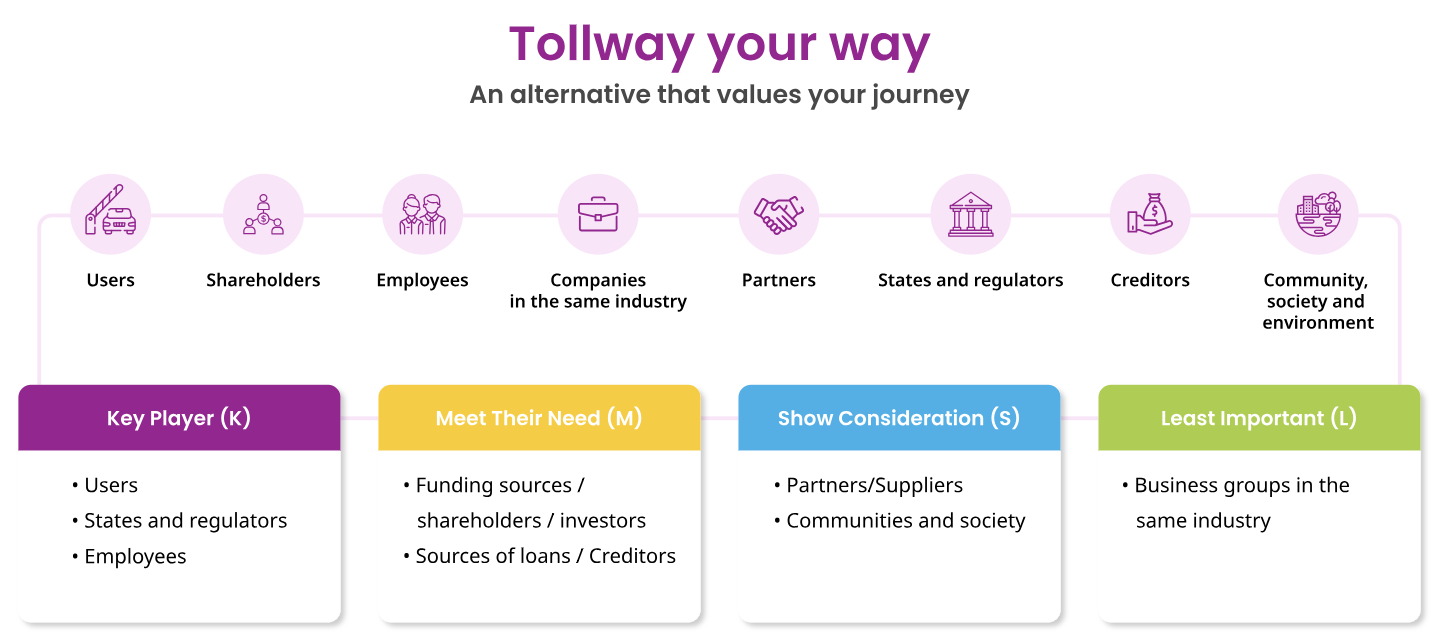
(2) The Role of Stakeholders The Company is aware of the rights of all groups of stakeholders equally, no matter whether they are Tollway service users, shareholders, employees, companies in the business group in the same industry, competitors, business partners, state agencies and other regulatory agencies involved in the business, creditors, community, society, and environment. The Company has set a policy to ensure that all groups of stakeholders receive proper, honest, and fair treatment from the Company and the Company strictly complies with all obligations pursuant to the contracts between the Company and all stakeholders. The Company’s practice guidelines for directors, executives, and employees are clearly stated.
The company has disclosed the guideline on "Managing Impacts on Stakeholders in the Business Value Chain" on its website under the Sustainability Development section or at https://www.tollway.co.th/en/sustainability/impact-management-to-stakeholders-in-the-business-value-chain |
Code of Conduct
Sub-Section Introduction
Realize the rights of all stakeholders equally. The Board of Directors has established a Code of Business Conduct that is consistent with key principles of good corporate governance as a guideline for personnel, including directors, executives, and employees to strictly adhere to and comply with in order to ensure that all stakeholders are treated appropriately, honestly, and fairly by implementing their commitments to all stakeholders.
Has a Business Code of Conduct
Yes
Code of Conduct Description
Taking into account the roles of stakeholders and responsible business operations
1. Responsibility to toll users
The Company deems that the Tollway users are great patrons who enable the Company to operate businesses continuously until present. The Company will provide services with honesty; provide corporate information and services accurately, adequately, precisely strictly complying with the laws relating to consumer rights. The Company is always willing to listen to suggestions, comments, and criticisms from the tollway users in order to further develop tollway services for convenience, safety, and satisfaction. Customer treatment is fair without discrimination. If there are problems with the service, coordination will be expedited to find solutions together. The Company will also not disclose customer information that they have known in the course of business operations, which is normally reserved and not disclosed unless it is a disclosure in accordance with the law. In addition, the Company will provide customers the opportunity to complain about service imperfections.
2. Responsibility to shareholders
To treat shareholders as owners of the Company by respecting the rights of shareholders with equal treatment as stipulated by laws and the Company’s regulations, as well as committing to providing shareholders with appropriate and consistent returns. The Company also organized an internal control and audit system, including an efficient risk management system as well as providing sufficient information to shareholders for investment decisions or related to material changes of the entity and will not disclose internal information to persons related to executives or directors that will cause damage to shareholders as a whole.
3. Responsibility to employees
Employees of all positions are essential to the Company and toll users. The Company has a policy to pay wages and fair remuneration with punctuality, as well as allocating welfare to employees as required by law, healthy care, and occupational safety. The Company supports continuous personnel development to be up-to-date, able to resolve immediate problems in a timely manner if an emergency occurs, including recruiting and retaining employees who are capable of performing tasks, focusing on development, promoting career advancement and stability.
4. Responsibility to companies in the business group in the same industry
Treat companies in the business group in the same industry under relevant laws and will conduct business with professionalism. In the past year, the Company has no dispute with partners in the similar industry (competitors).
5. Responsibility to suppliers and partners
It is deemed that the obligations under the concession agreements are of great importance to strictly and fairly adhere to the principles of international concession contracts and equality without discrimination and complying with conditions, framework, rules, and customs between each other.
To treat trading partners with integrity, adhering to the conditions set forth to all types of partners under the specified conditions, rules, and laws with honesty, transparency, and equality. Executives or employees involved in procurement, hiring, and services must disclose information and/or the nature of personal relationship of oneself, spouse, close relatives or personal relationship with one of the bidders that directly results in lack of transparency in the performance of duties and to show responsibility by not being involved in arbitration proceedings.
6. Responsibility to public sectors and other agencies related to the business
To comply with the laws which is a duty to the state and other regulatory agencies related to business such as tax payment, including regulations governing the state and other regulatory agencies relevant to the business in all aspects.
7. Responsibility to creditors
The Company is committed to fair treatment and be responsible to creditors, especially regarding the terms of guarantees, capital management, and in the event of a default payment clearly and concretely and disclose the practice to be known. Capital management, for example, the Company has a policy to maintain the liquidity ratio at a sufficient rate and to keep the debt-to-equity ratio at an appropriate level to have the ability for continuous debt repayment to creditors on time according to the conditions stipulated in the credit and guarantee contracts. The Company has a policy not to default on payment by resolving problems quickly in order to make debt repayment to creditors as per conditions stipulated in the credit agreement and guarantee contract.
8. Responsibility to community, society and environment
Adhering to social responsibility and be cautious in considering any action that may have negative impact on the public interest. Moreover, the Company focuses on operating and supporting activities beneficial to the community and society as a whole on a regular basis.
In treating the environment, the Company complies with environmental laws and regulations, as well as effectively caring for safety and environment of the Company in order to minimize impact on nearby communities, including promoting environmental responsibility conscience of employees.
Code of Conduct Practices
| Guideline | Detail | Document Link |
|---|---|---|
| Prevention of Misuse of Inside Information | The Company recognizes this important policy to prevent the directors, executives, and other persons connected to the Company from using their opportunities as director, executive, and other person connected to the Company to seek personal benefits and therefore put in place a code of conduct for directors, executives and other persons connected to the Company as follows: 1.1 Avoid doing a transaction connected with self that may cause a conflict of interest with the Company. 1.2 In case of necessity to do such a transaction for the Company’s benefits, do the transaction as if it is a transaction with an outsider, where the director, executive or person connected with the Company with a stake in the transaction is not involved in the approval thereof. 1.3 In case of a connected transaction under the notification of a connected agency, it must strictly comply with the criteria, methods, and requirement on the information disclosure of connected transactions of a listed company. 1.3.1 In doing a transaction that is a trade agreement in the same manner that a reasonable person should do with a normal party under the same situation of trade bargaining power without own influence under the capacity of director, executive or connected person, as the case may be, it shall have prior approval in principle with a budget ceiling for implementation of the transaction in accordance with the Company’s regulations on connected transactions. 1.3.2 A report summarizing the transaction with the size of transaction according to the principle approved under 1.3.1 shall be prepared for reporting to the Board of Directors’ meeting on a quarterly basis or as required by the Board of Directors. 1.4 Activities deemed to be a connected transaction not in compliance with trading transaction as in 1.3.1, it shall have prior approval from a meeting of the Board of Directors or a meeting of the shareholders of the Company in accordance with the Company’s regulations on connected transactions, as well as the relevant criteria of legal requirements. | |
| Anti-corruption | The Company adheres to business operations with honesty, transparency, fairness and in accordance with good corporate governance principles, as well as not accepting fraud and corruption both directly and indirectly. The Company has initiated operations and continuous development as follows: 1. Review, amend, and add content and operational processes in the Anti-Corruption Policy and the Whistle blowing Procedure. 2. Establish an annual work plan that complies and drives good corporate governance strategies and anti-corruption of the Company. 3. Arrange for a review on compliance with legal policies and corruption risk assessment of all departments within the Company, and to report to the Risk Management Committee on a quarterly basis. 4. Communicate and raise awareness about the company's Business Ethics Policy, Anti-Corruption Policy, and Whistleblowing or Complaint Measures through various communication channels. These efforts aim to ensure that both internal personnel and the general public using the company’s services have access to and understand these policies. | https://www.tollway.co.th/storage/document/cg/dmt-anti-corruption-en.pdf |
| Whistleblowing and Protection of Whistleblowers | Provide opportunities for directors, executives, employees, business partners, and stakeholders (“complainant” or “whistleblower”) to file a complaint on unlawful acts against regulations and the Company’s business ethics, which leads to deterioration in its assets and reputation, through whistleblowing channels provided as specified in the Whistleblowing Compliant Policy. The Corporate Governance Committee is responsible for appointing a committee for investigation, who has no conflicts of interest in the complaints, in order to scrutinize such leads or complaints. Scope of whistleblowing - Any act involving unlawful gains, including embezzlement, corruption, and bribery. - Fraud-related behavior or window dressing financial statements intentionally to deceive others by showing false statements or concealing the truth. - Behaviors related to transactions that violate the law, rules and regulations of the Company and business ethics. - Conduct of suspicious nature in connection with money laundering, window dress of accounting, finance, procurement, employment, and illegal operations that damage the Company’s reputation. - Actions that lead to conflicts of interest with the Company. | https://www.tollway.co.th/en/corporate-governance/whistleblowing-form |
| Preventing the Misuse of Inside Information | Clearly define measures to prevent misuse of internal information by defining the “policy on confidentiality, data retention, and use of internal information”, which is considered the responsibility of directors, executives, auditors, financial advisors, legal advisors, property appraiser, or any other person performing duties related to internal information, including employees or personnel or colleagues of such persons who are in a position or line of work related to internal information or confidential information of the Company in compliance with the laws. Policy and guidelines 1. Directors, executives, auditors, financial advisors, legal advisors, property appraiser, or any other person performing duties related to internal information, the Company’s employees or personnel who are aware of internal information or are in a position responsible for internal information or have access to imperative data that affects securities prices are prohibited from purchasing or selling the Company’s securities 1 month prior to the announcement of the financial statements and after the public has been informed through the information system of the Stock Exchange of Thailand for 24 hours. If there is a necessity to trade the Company’s securities, the Company Secretary must be notified at least 1 day in advance as specified in the Company’s Corporate Governance Handbook in order to be reported the Board of Directors’ meeting every quarter for acknowledgement. 2. Directors, executives, auditors, financial advisors, legal advisors, property appraiser, or any other person performing duties related to internal information, the Company’s employees or personnel who are aware of internal information or are in a position responsible for internal information or have access to imperative data that affects securities prices are prohibited from using or disclosing internal information to other persons either directly or indirectly by any means, knowing or should know that information recipients may use such information for the purpose of buying or selling securities, whether for themselves or others. 3. The Company Secretary or designated person will control, strict, and limit the use of internal information at least 1 month prior to the publication of the financial statements. 4. The Office of Company Secretary and CG / Company Secretary will be responsible for distributing the securities portfolio report form to directors, executives, and the Company’s auditors to fill out a report on securities portfolio of themselves, their spouses, persons living together as husbands and wives, minor children, and legal entities that holds more than 30% of the total voting rights according to the rules of the Securities and Exchange Commission. It is required that the report on changes in the holding of such securities is submitted to the Board of Directors’ meeting for acknowledgement, as well as disclosing in the Annual Registration Statement/Annual Report (56-1 One Report Form). Penalty Any violation that causes the Company’s damages or losses of business opportunity, the Company considers it as a violation of the policy and business ethics, which must be subject to severe penalty and also an offense under the Securities and Exchange Act B.E. 2535 (1992) (including amendments). | |
| Compliance with laws, rules and regulations | All personnel at every level must comply with applicable laws and regulations. Before engaging in any activities that may have legal implications, careful reviews and thorough examinations must be conducted to ensure adherence to relevant legal requirements. | |
| Use and maintenance of data and assets | The company establishes a policy for the confidentiality, retention, and use of internal information. This policy is the responsibility of directors, executives, auditors, financial advisors, legal consultants, property appraisers, and any other individuals involved with internal information. It also includes employees or contractors of these individuals who are in positions or roles that engage with internal information or must maintain the confidentiality of the company's information as required by law. Policy and Implementation Guidelines 1. Prohibition on Trading: Directors, executives, auditors, financial advisors, legal consultants, property appraisers, or any other individuals involved with internal information, as well as employees or contractors of the company who have access to internal information or hold positions responsible for such information, are prohibited from buying or selling the company’s securities within one month before the financial statements are announced and within 24 hours after the public has been informed of the information via the Stock Exchange of Thailand’s information system. If there is a necessity to trade the company’s securities, the intent must be communicated to the company secretary at least one day in advance using the prescribed format in the company’s good corporate governance manual, which will be reported at the quarterly board meeting. 2. Prohibition on Use or Disclosure: Directors, executives, auditors, financial advisors, legal consultants, property appraisers, or any other individuals involved with internal information, as well as employees or contractors of the company who have access to significant internal information, are prohibited from using or disclosing such information to others, whether directly or indirectly, and by any means, if they know or should know that the recipient might use the information for trading securities for themselves or for others. 3. Control of Internal Information: The company secretary or the designated individual shall strictly control and limit the use of internal information for at least one month prior to the announcement of financial statements. 4. Reporting Securities Holdings: Directors, executives, and auditors of the company must prepare and submit a report of their own securities holdings, as well as those of their spouses, cohabiting partners, minor children, and legal entities where the reporter holds more than thirty percent (30%) of the total voting rights, in accordance with the rules of the Securities and Exchange Commission. They must also report any changes in these holdings to the company board and disclose this information in the annual information report/annual report (Form 56-1 One Report) Penalty Provisions Any violation that results in damage or loss of business opportunities to the company will be considered as conduct contrary to the company’s policies and business ethics. Such actions will incur severe disciplinary penalties and may also constitute an offense under the Securities and Exchange Act B.E. 2535 (including amendments). | |
| Human rights | The Company conducts its business with integrity by adhering to social responsibility and all groups of stakeholders according to the principles of corporate governance and the Company’s code of conduct. In terms of human rights protection, the Company strictly complies with the laws and international principles, in particular supporting and complying with the Universal Declaration of Human Rights (UDHR), the United Nations Guiding Principles on Business and Human Rights (UNGP), and the International Labor Organization Declaration on Fundamental Principles and Rights at Work (ILO) to ensure that the Company’s business operations are free from human rights violation. The Board of Directors deemed appropriate to establish human rights policies to prevent human rights violations such as human trafficking, forced labor, child labor, discrimination, and harassment in all direct activities of the Company and its Business Partner in Business Value Chain. The Company respects and protects human rights of employees and stakeholders by strictly ensuring that the business does not involve in violations of human rights as specified by the laws and related agencies. For human resource management, including recruitment, employment, remuneration, development, promotion, and transfers, shall be no discrimination and equal opportunities are provided regardless of race, skin color, gender, language, religion, place of origin, and political views or any other status. | https://www.tollway.co.th/storage/document/cg/dmt-human-right-policy-en.pdf |
Promoting Compliance with the Code of Conduct
Promotes Compliance by Directors, Executives and Employees
Yes
Description
Realize the rights of all stakeholders equally. The Board of Directors has established a Code of Business Conduct that is consistent with key principles of good corporate governance as a guideline for personnel, including directors, executives, and employees to strictly adhere to and comply with in order to ensure that all stakeholders are treated appropriately, honestly, and fairly by implementing their commitments to all stakeholders.
Anti-Corruption Networks & Projects
Joined or Declared Intent to Join Anti-Corruption Networks
Yes
Networks & Projects Joined
| Network / Project | CAC Certified |
|---|---|
| Thai Private Sector Collective Action Against Corruption: CAC | Y |
| United Nations Global Compact (UNGC) | |
| Participation of anti-Corruption networks and initiatives |
Material Changes & Developments in CG
Reviewed the CG Policy or Board Charter in the Past Year
Yes
Material Changes or Developments in the Past Year
Yes
Policy Review — Description
In 2025, the Company remained committed to adapting and developing the organization to address future risks and opportunities, ensuring stable and sustainable growth. The Company focused on sustainable business planning covering Environmental, Social, and Governance (ESG) dimensions. Accordingly, the Board of Directors and the Management have continuously reviewed and updated the policies, guidelines, and Good Corporate Governance systems. These efforts aim to enhance efficiency and elevate the Company’s governance standards to align with the Corporate Governance Code for Listed Companies 2017 (CG Code). The key updates to the policies, guidelines, and corporate governance systems are as follows:
The Company enacted the revised Corporate Governance Policy on December 15, 2025. The amendments were primarily focused on Section 3: Key Policies Related to Corporate Governance, ensuring they comprehensively cover the Company’s operations, remain fully compliant with the CG Code 2017, and stay up to date with current standards. Details of the revisions are as follows:
1.1 Subsidiary Governance Policy
To establish an operational framework aligned with the parent company, enhance the efficiency of internal controls and risk management, and ensure the appropriate protection of investment interests in accordance with good governance principles.
1.2 Human Rights Policy
To define clear guidelines for preventing human rights violations in all dimensions—including employees, business partners, and communities—while elevating operations to align with national laws and international standards.
The full details of the corporate governance policy and anti-corruption policy can be found on the Company’s website at https://www.tollway.co.th/storage/document/cg/dmt-corporate-governance-policy-en.pdf
Furthermore, the Company has enhanced its best practices for the Board of Directors and corporate operations to align with the Corporate Governance Code for Listed Companies 2017 (CG Code). These enhancements include the review and revision of the Board of Directors Charter and the Sub-committee Charters. This process aligns with good governance principles, which state that the Board should ensure the roles and responsibilities of all sub-committees are reviewed to stay consistent with the Company’s policies, strategies, and business goals. Consequently, all sub-committees have conducted reviews and updates of their respective charters. To maintain ongoing suitability, the Board of Directors has mandated that the Board of Directors Charter be reviewed and assessed at least one (1) time per year.
In order to prepare a business plan, business risk management and opportunity management in a timely manner according to various situations and factors that may occur, the Company therefore organized a meeting of executives at all levels between 19-20 July 2025 to prepare a 5-year Business Sustainability Development Plan 2025-2029 by setting goals to create sustainability for the organization, focusing on delivering 3 dimensions of value: Environment, Social and Governance (ESG) to all stakeholder groups. Plans related to driving ESG issues were added with the executive group holding a workshop to brainstorm ideas, exchange opinions on considering projects and budgets to promote ESG sustainability. In 2025, the Company remained committed to continuous process improvement and the integration of technology to enhance energy efficiency and increase the utilization of renewable energy.
Reviewed and improvement of relevant operational guidelines to ensure alignment with the Corporate Governance Report of Thai Listed Companies (CGR) criteria and the SET ESG Rating for corporate sustainability development, as follows:
Review and update of the Sustainability Governance Manual to ensure consistency with the 2025 annual revision of the Good Corporate Governance Policy.
Review and update of the Human Rights Due Diligence (HRDD) Report, including the monitoring of business-related human rights issues and the enhancement of human rights operational procedures.
Encourage directors, executives, and employees to have knowledge and understanding about good corporate governance principles and practices and guidelines for corporate sustainability development by organizing activities to promote knowledge for the directors and encourage personnel to continuously attend various related training courses as follows:
Promote knowledge, understanding of the duties and responsibilities of the committee according to relevant laws, namely the Civil and Commercial Code, Public Limited Companies Act, Securities and Exchange Act, related rules and announcements, including compliance with good corporate governance principles, policies, committee charter, and the Company’s regulations. The Company Secretary will report changes in related laws, rules, or regulations on a quarterly basis.
Encourage directors to attend training/seminars under the curriculum of Thai Institute of Directors Association Regulatory agencies, including the Stock Exchange of Thailand and the Securities and Exchange Commission (SEC) or other interested agencies.
Promoting knowledge and understanding among directors, executives, and relevant employees who have access to the Company’s material information regarding the Prevention of Insider Trading. This initiative aims to prevent potential Conflicts of Interest and is conducted consistently every quarter through meetings and electronic mail (e-mail). All 11 members of the Board of Directors (100%) acknowledged the details as reported during the Board meetings.
Promoted knowledge, understanding, and skill development in sustainability strategy design through the training course "Materiality: Assessment and Utilization" held on July 19, 2025. The session was conducted by Ajarn Anantachai Yooprathum from the Sustainability Business Development Institute (SBDI). The program aimed to enhance understanding of the meaning and significance of Materiality within the contexts of sustainability, risk management, and corporate strategy. It also provided insights into the analysis and assessment of Financial Materiality from an executive perspective, linking it to financial risks and business strategies. This enables the effective utilization of Material Issues assessment results in strategy formulation, goal setting, information disclosure, and stakeholder communication.
Implements the CG Code for Listed Companies
No
CG Code — Description
The Company has considered applying Good Corporate Governance principles for Listed Companies 2017 or CG Code prepared by SEC, and the Company’s Board of Directors also emphasizes on the roles and responsibilities as leadership in applying the principles of good corporate governance in the organization to create sustainable value for the business. The assessment on compliance with the practices in each CGR Checklist against policy, corporate governance operations, and business context revealed that overall operation measures and processes are in line with the CG Code, suitable for business growth direction. However, there are still some criteria that the Company has yet to implement and can be summarized as follows:
CG Code / CGR Checklist | Reasons and Measures of the Company |
The Chairman of the Board of Directors should be an independent director (CG Code item 3.2.1 / CGR Checklist item E 69) | The Chairman of the Board of Directors is not an independent director because the Company’s business is complex, and therefore requires an experienced leader with an understanding of managing a long concession business. As a result, the Company has clearly defined guidelines on conflicts of interest and the Board of Directors promotes a balance of power between the Board of Directors and the management. The Chairman of the Audit Committee or the Chairman of the Nomination and Remuneration Committee, who are independent directors, are to jointly set agendas for the Board of Directors’ meetings, including sufficient internal control. |
The Board of Directors should set a policy for the tenure of independent directors to not exceed 9 years, without exception. (CG Code section 3.2.5 / CGR Checklist section D 13) | The Company has set the term of office for independent directors to not exceed 9 years by considering the election of independent directors. The Board of Directors has considered independence, appropriateness, and efficiency in performing duties of independent directors, as well explaining the reasons for consideration by shareholders in the election of independent directors every time. All independent directors of the Company must have full qualifications and can express opinions independently in accordance with relevant criteria. At present, the Company has no independent directors who have held the position for more than 9 years since the Company became a liste company. |
Other CG Performance & Outcomes
With determination and strong intention to operate business on the basis of good corporate governance in addition to complying with CG Code of Listed Companies, DMT’s operations also various assessments of listed companies such as Quality Assessment of the Thai Investors Association’s Shareholders’ Meeting, and Assessment of the Thai Private Sector Collective Action Coalition Against Corruption by the Thai Institute of Directors Association (IOD).
In addition, the Company also places importance on the disclosure of information that is accurate, complete, transparent, and thorough, including financial reports and general information as well as important information that affects the stock price of the Company. The aforementioned information and news is disseminated to investors and related parties such as notification via the Stock Exchange of Thailand’s electronic systems, the Company’s website, or press releases. The Company’s management team communicates directly with shareholders, institutional investors, and domestic securities analysts by providing information on the progress of business operations and answering various inquiries concerning the Company to investors on a quarterly basis; and giving press releases in addition to disclosing information to the Stock Exchange of Thailand and via the Company’s website www.tollway.co.th, which is constantly updated so that all groups of the stakeholders who are involved in the Company’s activities are notified of the updated information equally.
In addition to providing opportunities for securities analysts and investors to meet with the Company’s executives to inquire about the performance and business visits, the Company also arranges analyst meetings to clarify business overview and attend the Opportunity Day organized by the Stock Exchange of Thailand on a quarter basis. This is to promote good relations between executives and investors in order to create a better understanding of the Company’s business.
In 2025, the Company has arranged to provide information to investors, institutional investors, analysts, and other activities as follows:
Information Presentation Activities | Number of Times |
Opportunity day | 4 |
Analyst Meeting | 2 |
One on group meeting (Domestic investors) | 1 |
One on group meeting (Foreign investors) | 2 |
Company Visit | 2 |
Meet the press | 2 |